
Published AI Research (2023)
This project began when I read an article about AI composing a song in the style of The Beatles. When I listened to the track, I was stunned. The lyrics, mostly written by AI, sounded impressive and authentic to the style the Beatles wrote in. That moment sparked a big question for me: If AI can write music, can it write content, too? In other words, would artificial intelligence take my job one day?
At the time, AI wasn’t a mainstream topic. A few companies were experimenting with AI-generated writing, but the public saw it as science fiction. No one at East Tennessee State University had yet written a master’s thesis on the concept of AI taking jobs. But I believed in the topic.
So, using qualitative content analysis, I reviewed around 50 sources to identify emerging themes about AI’s creative potential. My research documented that by far the most entrenched view on the impact of artificial intelligence on the content strategy job market is that AI will not replace the creative professional but rather act as a creative assistant — a tool to automate repetitive tasks so humans could focus on strategy and big-picture thinking. I connected these ideas to the philosophies of Steve Jobs and Alan Turing, both of whom viewed computers as extensions of human intelligence rather than replacements for it.
It is impressive to me how quickly AI has evolved from a nice-sounding theory to the emergence of ChatGPT, the realignment of every tech company in the world around AI-first products, and the elimination of hundreds of thousands of jobs due to growing implementation of AI infrastructure. I believe the true nature and capabilities of artificial intelligence are still widely misunderstood, but I still believe it will continue to transform creative industries over many decades by eliminating non-creative, repetitive, lower-value tasks that impede higher-revenue strategic and creative work.
Masters Thesis Abstract
Whereas prior research on artificial intelligence has dealt with automation in fields like medicine, engineering, and computer science, this research study seeks to answer the question, “To what extent can AI be creative in the context of content strategy?” To answer this, this study employs content analysis using 16 online news and blog articles from primarily marketing organizations to identify and explain key variables surrounding the relationship between the computer and the creative professional.
This study has found that the core belief that AI will play the future role of creative assistant in the context of content strategy is shared among many online marketing publications. As AI becomes increasingly capable of taking on lower level creative tasks such as content organization, ideation, basic copywriting, and photo editing, many believe this will open up more time for content strategy professionals to accomplish more creatively demanding, big picture tasks.
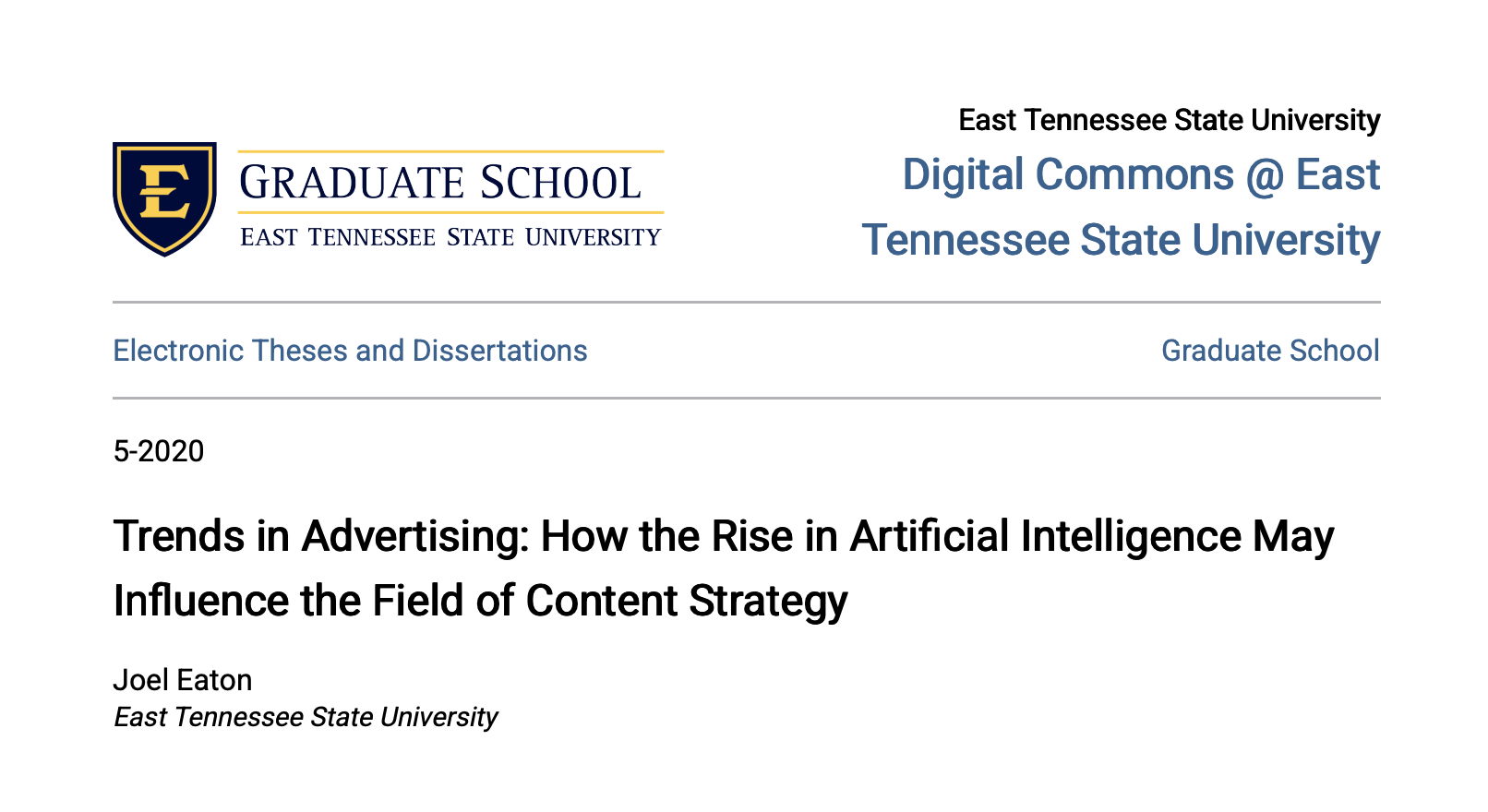
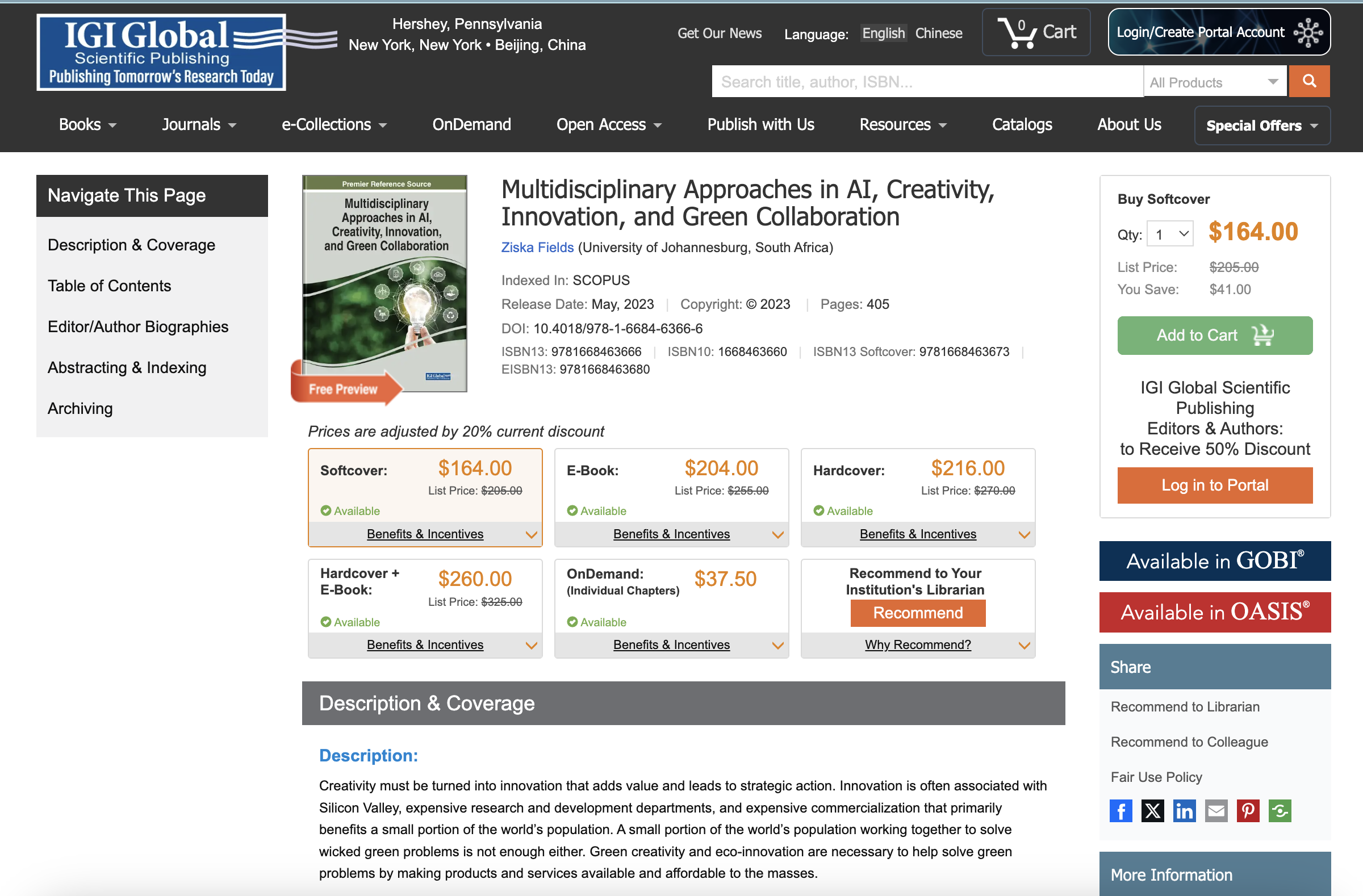
A few years after my masters thesis was published with East Tennessee State University, my former thesis advisor, Dr. Melanie Richards, contacted me about becoming a secondary author for a project she and one of her students were working on. As a result of my thesis work being included, I am now a secondary author on a published article in the journal IGI Global Scientific Publishing in their 2023 issue Multidisciplinary Approaches in AI, Creativity, AI, Innovation, and Green Collaboration.
Published Research Abstract
Artificial intelligence (AI) is increasingly reshaping brand and marketing communications. While significant research has been conducted on the impact of AI in other fields, there is little empirical evidence on how artificial intelligence is affecting the customer journey. This research study seeks to answer, “How is artificial intelligence influencing both organizational content strategy and the related customer journey?”
To answer this, the authors employed mixed-methods qualitative research via a content analysis of industry publications, a series of in-depth customer interviews, and a case study content analysis of two organizations that are using AI to varying degrees within their content strategy. This study found that many publications agree AI will play a future role as creative assistant in content development, that consumer perceptions about AI and cognitive dissonance impact levels of adoption to some extent, and that companies in different geographical locations may have different levels of AI adoption along innovation stages.